Dog Rescues or Dog Shelters – Where To Find A Cockapoo?

Are you looking to Re-home or Rescue a Cockapoo?

Many people looking for a Cockapoo would like to rescue a dog. But where should you start your search? Rescue Cockapoos are in demand but don’t expect to be offered a puppy.

First off, lets look at the differences between a dog rescue and a  dog shelter.
Rescue dogs are often located in foster homes.  Mostly you will be dealing with individuals, normally fans of the breed.  For the Cockapoo the CCGB has a waiting list which can be found here .

What is Respite Care

Sometimes people’s circumstances change and they just need some time away from their dog. That’s when a home is needed to give the owner respite from dog ownership. People move locations to a home where dogs aren’t allowed; have a relationship break up – there are many reasons people have to re-home their dog for a temporary period.
rescue cockapoo
Many older dogs need re-homing and are adorable

Dog Shelters

This is a physical building you can visit because the shelter has accepted the dog permanently.
Animal shelters have varying degrees of standards. Some are good some are not so good. It’s easy to fall into the mind set that since a dog shelter is a place of help you need to just accept its procedures.
That would be a mistake.  You should use your judgement about and be mindful of what you may be taking on. These are all important questions you should be prepared to ask.

Rescue Cockapoo Questions

  • Do they have a clean premises
  • Are all dogs have up to date vaccinations and deworming
  • Do they micro chip all dogs
  • Do they spay and neuter all dogs
  • Have they assessed using a true temperament test
  • Will they take the dog back if things don’t work out
  • Do they have a adoption application
  • Do they charge reasonable adoption fees
  • Do they charge reasonable transportation fees
The ebook Rescue Cockapoo, is part of the Cockapoo Bundle of Books

Resources:

http://www.nokillnetwork.org/uk/
http://www.peta.org/blog/won-t-work-kill-shelter/
https://cockapoo.me/cockapoo-rescue-pages/


Cockapoo


How To Handle A Cockapoo Puppy For The First time

Cockapoo puppy training 101

One of the things we often forget is that not all dogs naturally enjoy being groomed, handled or cuddled. We have to teach them that these things are a normal and natural part of family life. This is a foundation to training a Cockapoo puppy as it creates a lovely bond between owner and dog.

Sometimes if some one is bitten it’s because a dog reacts fearfully to being handled. That’s because he’s never been taught what a joy it is!

Doggy body language

Body language is very different for dogs. Have you noticed how a dog barks when he sees two people  hugging? Dogs just don’t understand it because hugging is not how a dog shows affection.

You have to teach your Cockapoo how to enjoy being hugged and cuddled.

For owners who have children or people that just love the physical interaction and pleasure of cuddling their dog, this is one of the best things you’re ever going to teach him to do.


[embedyt] http://www.youtube.com/watch?v=yk0KNJLhaT0[/embedyt]

To begin

You will need a good supply of yummy treats. While giving him his treat, slowly start to stroke him.

Start by stroking him where you know he will be comfortable being stroked. Down the sides of his body, up his ears, down his paws. Eventually turn him over and rub his tummy.

You are giving the treats so he links in his mind your stroking him with feeling good.

If you find an area where you dog shows concern about being stroked, just stop and go back to an area he is comfortable with and gently introduce him to being stroked in that area.

Always take it very slowly and very gradually and build it up over the time your working with your dog.

Early grooming

Sometimes you can use a brush or a fluffy glove. And while he’s chewing his treat he’s learning that brushing and stroking is really enjoyable.

Get everyone in the family to do this. Everyone must know the dog needs to be handled nicely and with respect, so that your dog knows hands are always something to be enjoyed rather than something to be worried about.

You can find more positive reward-based training techniques with the ‘Training Your Cockapoo’ hand book.

Cockapoo


Can my Cockapoo be a therapy dog?

Share your Cockapoo to benefit others

A therapy dog is a dog that is used to benefit a person in a therapeutic way. Obviously some breeds lend themselves to this more than others.

Cockapoos provide much happiness to their owners sometimes people want to share their love and good nature with others. You may have heard of the pat and stroke schemes.

Essentially though many dog breeds that have a suitable disposition can be a therapy dog. The deciding factor is whether they are suitable for the purpose that is required. Factors to consider are your Cockapoo’s age, temperament, health, and level of basic obedience training.

Benefits of a Therapy dog

  • Physical –occupational therapists sometimes include a dog in a patient’s treatment plan. A common exercise might be bending down, holding a brush and brushing the dog’s coat– a simple but enjoyable exercise.
  • Psychological – lap dogs can: increase self-esteem; ease stress after trauma and help with self-confidence and provide much needed companionship after a bereavement. Dogs are also sometimes used to improve the mood of children in paediatric hospitals.
  • Social – animals can act as a social enhancer and help people adjust to a new environments and make meeting new people less daunting.  The SCAS conducts research into these benefits.

Can my Cockapoo become a therapy dog?

Cockapoo therapy dogs for good health

It really depends on what you want him to do. In the UK there are two main organisations that manage visiting programmes along with some other therapeutic activities.  The charity Pets as therapy  will do an assessment with your Cockapoo to determine his suitability to take part in any specific activity.  I recommend contacting them if you would like to explore this further.

Is a therapy dog an assistance dog?

No. Therapy dogs are not classified as assistance dogs. This is because an assistance dog is trained to carry out special tasks to aid a disabled person. They’re generally qualified by organisations registered as members of Assistance Dogs UK.

Where can I get my Cockapoo trained as a therapy dog?

The SCAS runs fun interactive courses. You can register you interest here.

Summary

Getting your Cockapoo trained as a therapy dog is lovely thing to do for those in need and also helps spread the knowledge about the benefits of our wonderful Cockapoo breed. It may be worth a try!
Cockapoo


Do Cockapoos Shed?

Cockapoos have a reputation for not shedding hair – but is it true?

The beauty of a hybrid dog is that undesirable traits can be ‘breed out’ or at least minimised by selecting a parent breed whose desirable qualities the breeder wants to genetically carry through to the offspring.

It’s not known for what purpose a Cocker Spaniel and Poodle were originally cross bred (all though the benefits are clear), but one plus is the poodle’s tight curled hair has always appealed to those who don’t want to be hovering up too much hair in their home.

do cockapoos shed
All dogs shed hair

Puppy fur to Adult Cockapoo Coat

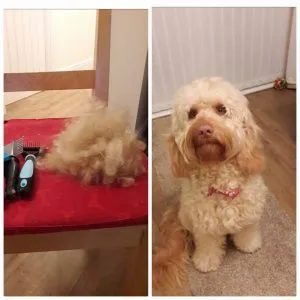
There is an age when all Cockapoos will definitely shed hair – when they loose their puppy fur and their adult coat comes in. This natural process of moulting is unavoidable but regular daily or twice daily grooming will mean less hair on your sofa! The adult coat generally ‘comes in’ at around 8 months of age.

Fyi, remember, if the moult is not groomed out, your Cockapoo’s lovely coat will start to matt and even grow into dreadlocks.

Wavy or curly coat

Moulting aside, Cockapoos still have a reputation for non shedding because of the poodle lineage.  But what if the puppy inherits its coat from the Cocker? Results will vary.

Some First Cross ‘F1’ Cockapoos take after the Cocker Spaniel so offspring will have wavy hair that can grow up to 15cm long.

So if you are intent on having a low shedding Cockapoo you need to choose a puppy whose coat follows the poodle heritage.

Will the breeder know?

Breeders know a lot of things but they won’t be able to tell before 6 weeks what kind of coat an F1 Cockapoo puppy will have. And if the puppy does take after the Cocker, dog owners will tell you some Cocker Spaniels shed like crazy while some shed hardly at all. Some Cockers can get up from their bed and hardly leave any hairs while another Cocker when you stroke their back you come away with a palm full of hair.

Summary

To be honest it is a bit of myth that Cockapoos don’t shed – all dogs shed to some degree. The poodle factor has garnered the Cockapoo with the reputation as a non to light shedder but the truth is they will be light shedders at best.

When choosing a puppy, wait until 8 weeks (as you always should) before taking a puppy home from its mother. By that time it should become clear what sort of coat (wavy or curls) the dog has inherited. If the puppy’s coat is inherited from the Cocker side of the family just keep her coat short and groom often to lessen the shedding.

Finally, remember also that Poodle parents come in sizes: Teacup, Toy, Miniature and Standard. The smaller the dog the fewer the hairs shed.

Related Article: Are Cockapoo’s Hypoallergenic 

Want to know more about the Cockapoo? Your First Cockapoo is a good place to start.


Cockapoo Health Problems: 7 Genetic Diseases Cockapoos Inherit

Cockapoo Health Problems

Like all dogs, Cockapoos  are susceptible to some genetic diseases. The parent breeds used to produce a F1 (or first cross) Cockapoo puppy will pass on hereditary diseases if not tested for breeding suitability.

This is the same for all dogs but the list below is particular for Cockapoo Parent dogs (the male and female are known as dams and sires or stud dogs ). If health tests are not carried out before breeding, the breeder and the eventual owner of the Cockapoo puppy might unknowingly be accepting a Cockapoo with health issues in later life.

As a buyer, it’s far better to understand what testing you should insist on seeing original written documentation for, rather than risk having Cockapoo health concerns as your puppy matures.

Below is a list of the most prevalent diseases to scrutinize to ensure you buy a healthy Cockapoo!

Four month old cockapoo puppy

Prcd-PRA – (Progressive Retinal Atrophy)

What is it: A genetic disorder that causes blindness. Cells at the back of the retina gradually decay and die leaving the dog suffering from night blindness and most likely full blindness by end of life.

Onset age: Early adolescence / adulthood

Symptoms: Night blindness, gradual short slightness

Cure: No

Prevention: Test parents before breeding

Parent dogs affected: American Cocker Spaniel / English Shower Cocker / English Working Cocker / Miniature Poodle / Toy Poodle

Health testing: Always. For all registered cockapoos one parent must be clear.

FN – Familial Nephropathy

What is it: A recessive inherited disease that destroys nephrons (cell structure that makes up the kidney)

Onset age: six to 24 months of age

Symptoms: drinks more, urinates more, weight loss, lack of appetite, vomiting, or diarrhea

Cure: No

Prevention: Test parents before breeding

Parent dogs affected: English Shower Cocker / English Working

Heath Testing: Always –  Always for all registered Cockapoos. (F1 and poodle back crosses are exempt) carrying English Show & Working Cocker Spaniel genes, must have one parent clear/normal.

Phosphofructokinase (PFK)

What is it: Phosphofructokinase (PFK) is an essential enzyme needed to produce energy. The disease occurs when the gene mutates and stops producing energy from sugar sources within the dog.

Onset age: adolescence / adulthood

Cure: none

Symptoms: jaundice, sudden weakness, cramping, and anemia

Prevention: health testing

Parent dogs affected: American Cocker Spaniel

Health testing: Always for all registered Cockapoos. (F1 and poodle back crosses are exempt) carrying American Cocker Spaniel genes must have one parent clear/normal.

Glaucoma

What is it: Primary Glaucoma is caused by increased pressure build up within the eye. It is classified as either primary or secondary. The eye’s drainage becomes blocked, but the eye keeps making fluid. As a result, pressure on the eye increases.

Secondary glaucoma

What is it: Occurs when other eye diseases cause fluid drainage problems. With secondary glaucoma be watchful for eye inflammation, cataracts, retinal detachment and movement of the lens.

Onset age: Adolescence / adulthood

Cure: It is crucial to determine if the dog is affected by primary or secondary glaucoma. The treatment needed and the prognosis for vision is different for each type.

Symptoms: Can start in just one eye

Prevention: Annual vet check-up can prevent secondary glaucoma. The British Veterinary Association (BVA) also have a scheme for specialist Canine Opthalomogist. A manual examination of the eye needs to be done.

Parent dogs affected: American Cocker Spaniel / English Shower Cocker / English Working Cocker / Miniature Poodle / Toy Poodle

Health testing: Preferable

Von Willebrand disease TYPE 1 (vWD1)

What is it: A bleeding disorder. vWD1 is a protein that  enables blood clotting.

Onset age: Early adolescence / adulthood. Often discovered after nail trimming, teething, spaying, sterilizing, tail docking, cropping

Cure: Type 1 is only results in mild bleeding. Type 2&3 are more severe and bleeding can occur in intestines, stomach, urinary tracts, genitals and joints

Symptoms: Spontaneous bleeding from the nose, gum and other mucous membranes. Excessive bleeding occurs after an injury, trauma or a surgery.

Prevention: Testing before breeding

Parent dogs affected: Miniature Poodle

Health testing: Advisable

Hip dysplasia

What is it: Hip dysplasia is an abnormal development within the hip joint, which leads to deformity in the joint.

Onset age: 14 to 26 weeks of age. The developmental ‘primary’ changes appear first. The secondary changes may be referred to as Degenerative Joint Disease or Osteo Arthrosis or Osteo-Arthritis.

Cure: Hereditary hip dysplasia is not curable. Secondary hip dysplasia can be treated as its primary cause is wear and tear

Symptoms: As Hip dysplasia can include joint looseness (laxity), inflammation, pain, new bone formation and bone erosion, changes in gait to pronounced lameness, stiffness after exercise.

Prevention: Not over exercising, particularly developing puppies in their first year.

Hip Score

BVA/KC Hip Dysplasia Scheme scores radio graphs. The lower the ‘hip score’ the less the better. The minimum (best) score for each hip is zero and the maximum (or least desirable) is 53, giving a range for the total score of 0 to 106.

Sires (fathers) to be bred from should ideally be ones whose offspring have consistently low scores. The same selection procedure should be used for breeding bitches, since the use of animals with higher scores will increase the risk of producing offspring with higher scores.

For fees and further information  contact: CHS, 7 Mansfield Street, London, W1G 9NQ.   Tel 020 7908 6380   Email chs@bva.co.uk     /  www.bva.co.uk/chs

The breed mean score: The suggested mean score for Cockapoos is 12/13.

Parent dogs affected: American Cocker Spaniel / English Shower Cocker / English Working Cocker / Miniature Poodle / Toy Poodle

Health testing: Advised

[see diet and Hip Dysplasia]

Retinal Dysplasia

What is it: Retinal dysplasia appears as streaks and dots in the central retina affecting a dog’s eye site. Most cases are hereditary.

Onset age: Adult dogs

Symptoms: Mild retinal dysplasia may not show symptoms. In dogs with more severe cases, the symptoms may include being afraid of the dark (even inside the house), bumping into things and noticeable visual impairment.

Cure: None

Prevention: Other than an inherited condition, retinal dysplasia may be bought on by prenatal infections like the the Herpes-virus. Herpes-virus causes inflammation of the eye and retinal dysplasia may develop later on in life. Also Parvo-virus and exposure to toxins can cause retinal dysplasia in dogs.

Parent dogs affected: American Cocker Spaniel

Health testing: Advisable

Summary

Most Cockapoo health problems can be avoided by Cockapoo Breeders UK. Why roll the dice and buy a puppy off the internet – it will probably end in heart break
Cockapoo


Is Sleeping With Your Cockapoo Bad For Your Health?

Do you sleep with your cockapoo?

sleeping with your cockapoo

The subject of how many people sleep with their dogs was discussed at last year’s annual meeting of the Associated Professional Sleep Societies. A survey they had commissioned reported half of patients who had sought help with their tiredness slept with their pets.

Cockapoos in particular are a breed that lends itself to being a popular nocturnal partner.

Why Is this the case?

1. As a companion dog a large proportion of cockapoo owners are single. With no partner to share a bed it’s easy for a dog to take the place of another warm body. At bed time it’s understandable that people want a bit of animal comfort and your adorable cockapoo is eager to oblige.

Dogs are looking for humans to re-create the warmth and security of the litter where they learned to be happy co-sleepers who want to snuggle up. Psychologist Stanley Coren refers to speculation among anthropologists that human-canine co-sleeping may even be encoded in our respective DNA.

2. Cockapoos are compact. It’s not like you’re making room for Saint Bernard. The largest cockapoo would be a Standard or Maxi weighing no more than 19 lbs. / 8.61 kg. The UK standard is slightly bigger than the American version of 15 inches with the longest being 24 inches long. So no need to go and buy a bigger bed.

3. They are very cuddly. Cockapoo owners would agree these are the cutest dogs on the planet. Their looks have propelled them to being one of the most popular dog breeds. On a cold night what could be more irresistible than hugging something this cute.  Also a dog’s body temperature is approximately three to six degrees warmer than our own.

4. They won’t leave too much fur behind. Cockapoos are often referred to as non-shedding. This isn’t quite true. But they are minimal shedders so you won’t have to be shaking out the duvet in the morning.

Here are some tips for a better nights sleep with your cockapoo:

  • Brush his teeth regularly. Bad breath is never welcome so make sure you brush regularly with a branded doggy toothpaste.
  • Avoid dog food that makes him flatulent. Experiment with giving your cockapoo the right blend of kibble and wet food. Too much canned wet food will often cause flatulency in a dog.
  • Don’t take him under the covers. Dogs don’t get a solid eight hours like humans. They mostly doze and like to move around a lot. Keeping them under the duvet will constrict their nocturnal movements causing them to wake you up.
  • Make sure your cockapoo is not over weight. As well as being a precursor to many health issues, an overweight dog is likely to snore.

In Summary

The Division of Sleep Medicine at Harvard Medical School reported that “chronic sleep deprivation may lead to a host of health problems including obesity, diabetes, cardiovascular disease, and even early mortality.”

Remember sleep deprivation is a torture technique so if your cockapoo doesn’t make a good bed fellow for whatever reason, be firm and deny him your bed.

However, if you follow the guidance above, sleeping with your cockapoo can be a great comfort for dog and owner.

Cockapoo


How to Bath Your Cockapoo Puppy For The First Time

How to bath your cockapoo puppy
credit: https://www.flickr.com/photos/andrewgospastic


If you have just bought a cockapoo puppy home for the first time you may be wondering when he needs his first bath?

And how often you should bath your puppy after that?

The answer is you only need to bath him when he needs bathing.

Why is this?

Although cockapoo fur does vary between short poodle-like fur and longer cocker-style hair, your puppy will have a thick fur coat. And within a few months, this soft puppy coat is replaced by an adult fur coat.

The Adult Fur Coat

When the adult fur comes it will have the added benefit of being very water proof.

The natural grease and oils that a dog secretes, coat each strand of their hair. You may have noticed a greasy smearing on a white pillow or wall if your dog has come into contact with it.

Bathing your cockapoo regularly will wash the natural grease and oils from his coat. Not only will the coat loose its natural lustre, when your puppy gets wet he will be more cold and take longer to dry.

Of course, if your puppy roles in something smelly he will need a bath, but for minor mishaps and dirty paws try using wet wipes to clean him up.

What Shampoo?

If it’s essential to bath him then don’t reach for a human shampoo. The chemicals it contains are not designed for a puppy’s sensitive skin. It may lead to skin complaints.

A baby shampoo can be used but a puppy shampoo is ideal.

Where to bath your Cockapoo puppy

Most puppies are quite intimidated by a big white bath tub and it can cause your puppy to panic.

Pick a place where your cockapoo knows he is safe like the kitchen sink.

For very small puppies a plastic tub on the kitchen floor would be ideal.

It’s bath time – be prepared

Until your little cockapoo has got used to the bathing routine I recommend having two people doing the job. A wet wriggling puppy can be hard to manage.

Make sure you are using warm water and have a plastic cup for rinsing. You will also need several hand towels.

Favourite treats are always a good idea to reward your puppy for calm compliant behaviour.

Washing your puppy

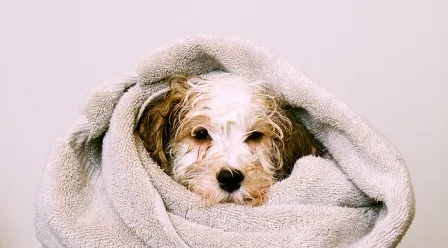
bathing your cockapoo puppy

Take your time wetting your puppy slowly using  the plastic cup while using your best soothing, reassuring voice. You will notice because his fur is water proof it takes some time to get them thoroughly wet.

Take a good amount of the puppy shampoo and spread it down your puppy’s spine massaging gently. With slow deliberate strokes start working your hands into the fur coat. Then gently do each leg in turn. Lastly do his tummy and bottom.

The face should not be washed with shampoo unless absolutely necessary. Again wet wipes are usually fine. And always remember to keep the soap away from your puppy’s eyes.

Once your puppy’s fur coat has been thoroughly washed with the shampoo change the water in the bowl. With fresh warmish water you can then begin to rinse him off with the plastic cup.

Don’t forget to be generous with treats. This will help your puppy remember bath time isn’t a bad experience!


When he’s done

If you do have a helper it’s a good idea that one washes and one dries. Once you have rinsed all the shampoo from the fur scoop him up and place him in your helpers lap. They should have a hand towel on their lap and another one to dry.

Now comes the fun part for your cockapoo puppy as they love getting dry!

You will find no matter how good a job you do towelling him off as soon as you put him down he will want to shake himself.

Finally, leave him to air dry in a warm part of the house and leave a towel out for him to play with and roll dry. You may want this to be away from your living room as the wet dog smell is inevitable 😉

If you’re going to use a hairdryer try and get your puppy used to the noise first. Remember to set it on low heat as it can get hot fast on his sensitive skin. Try and dry the fur through your fingers so you can make sure his delicate puppy skin is not getting too hot.

Wrapping it Up

A false start with bathing because you’re upset or stressed your puppy is messy can cause your cockapoo to be apprehensive about bath time.

Like every aspect of socialising your puppy, try and make it fun and enjoyable so they are relaxed about the routine next time.
Cockapoo


Cockapoo For Life
Privacy Overview

This website uses cookies so that we can provide you with the best user experience possible. Cookie information is stored in your browser and performs functions such as recognising you when you return to our website and helping our team to understand which sections of the website you find most interesting and useful.